

I am a graduate in Public International Law from the University of Paris (DEA, 1994) and the University of Michigan (LL.M, 1996), and in Public Management from the University of London (SOAS) (2014).
Before acting as a consultant, I have been working for 20 years as legal counsel with international organisations.
A Legal Officer for a Trial Chamber of the ICTY from 1998 to 2004, I contributed to the first post–Second World War cases involving war crimes, crimes against humanity and genocide. This experience has anchored a strong human rights perspective in my legal practice ever since.
As Legal Adviser to the CCNR between 2005 and 2014, I gained first-hand expertise in all legal aspects of inland water transport, including private law, economic regulation, safety and social standards. I carried out extensive work on the social rights of inland waterway transport workers, focusing on qualifications, career paths, working conditions and social security. I also had the privilege of cooperating on the 2012 revision of the CLNI.
While advising the AQUAPOL network from 2019 to 2024, I worked closely with law enforcement officers from 18 countries, gaining in-depth insight into criminal activities and enforcement mechanisms in waterborne transport and fisheries, including illegal labor practices, illegal fishing, smuggling, oil spills and oil blending.
Since 2015, as an independent legal consultant, I have advised on social rights, market rules, contracts and civil liability, environmental protection and governance models relating to waterborne transport and fisheries. I have advised at all stages of the policy life cycle, from policy formulation, to implementation, evaluation and maintenance.
Water transport and fisheries provide essential goods, energy, food, construction materials and chemicals, yet the social and environmental conditions under which these activities are carried out often remain overlooked.
The legal frameworks governing the social rights of fishers and waterborne transport workers are complex and challenging to enforce, due to the highly mobile nature of the work and the globalised structure of the industry. Technological innovation and automation are reshaping working conditions and career paths.
Climate change heavily affects these sectors. While freedom of commerce and navigation remains a core value, public support is indispensable to navigate these transformations.
Effective solutions require close cooperation between private stakeholders and public authorities.
Through my legal work, I strive to contribute to decent working conditions, promote environmentally sustainable practices, and help preserve an open, liberal economic model while addressing the impacts of globalisation.
Publications
I regularly share my analyses and insights on legal developments relating to river transport, fishing and maritime transport in my publications.
Speaking engagements in 2025
- Crewing requirements, e-tools and the Working Time Directive,
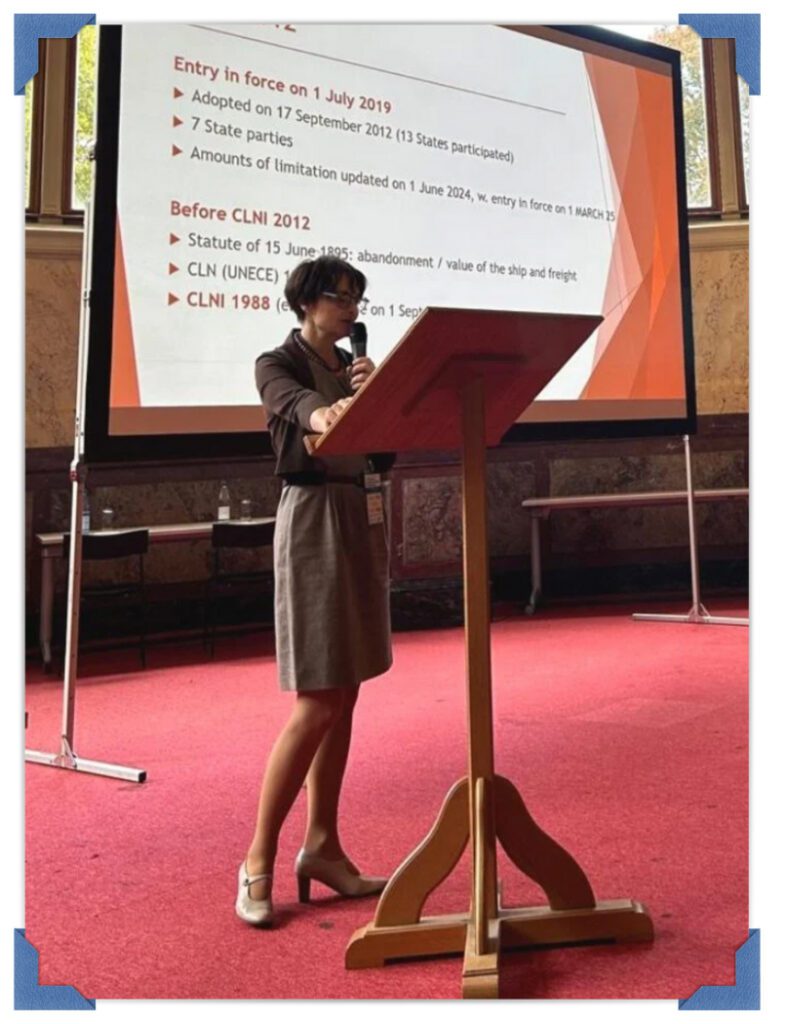
Sectoral Social Dialogue Committee for Inland Waterways Working Group, 12 Nov 2025 - The application of the CLNI in recent Case law,
17th Mannheim conference on inland navigation law, Strasbourg, Institut für Transport- und Verkehrsrecht, Universität Mannheim (10 oct 2025) - Social security for seafarers and inland water transport workers : current legal framework,
Social security coordination in the transport sector : challenges and way forward, Conference co-organised by ETF and ELA, Bratislava (8 October 2025) - Possible legal remedies following the accident of 8 December 2024 at the Moselle lock of Müden,
Legal Committee of the Moselle, 31 March 2025
MEMBER OF
Cécile Tournaye
Senior legal consultant
Follow me on Linkedin
© Copyright 2025 - All reserved rights
Created by Aurélie Ragueneau